 Hastimal Jangid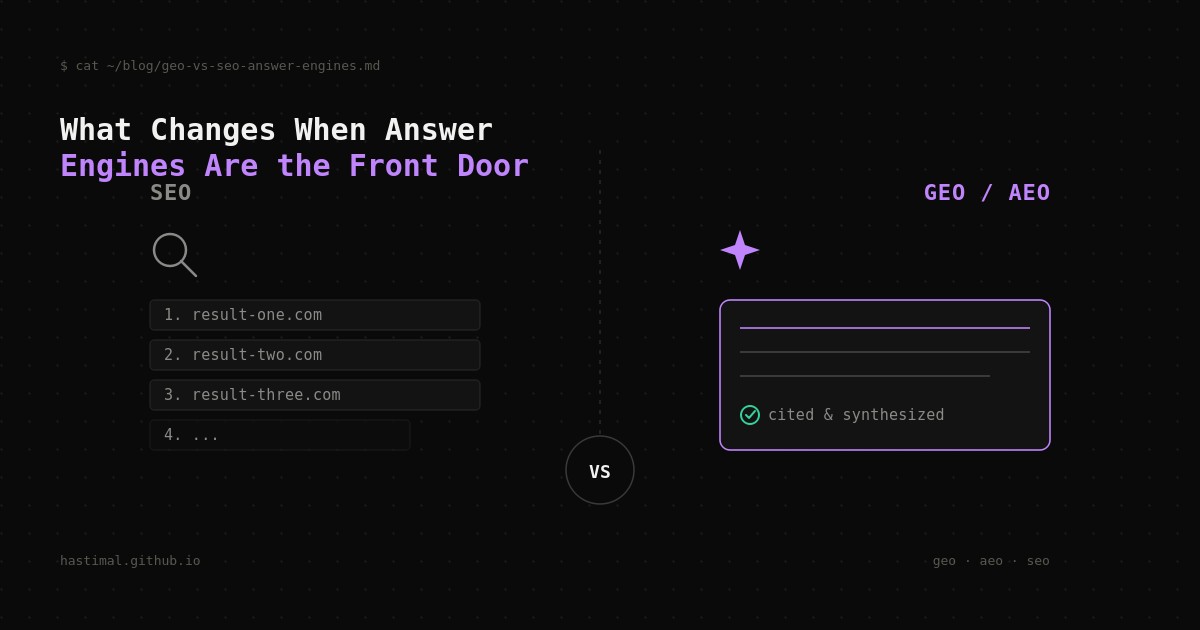
The easy version of the GEO story is "SEO but for ChatGPT." It's not wrong, exactly — a lot of what makes content rank well in Google still helps it get cited by an AI answer engine. But treating GEO as SEO with a new acronym misses the two or three things that are genuinely different, and those are exactly the things most teams get wrong first.
What actually carries over from SEO
Structured, well-organized content still wins. Clear headings, direct answers near the top of a section, and content that actually answers the question in the title — none of that stopped mattering. Technical crawlability still matters too: if an AI crawler can't parse your page, it can't cite your page, the same way Googlebot couldn't rank what it couldn't read.
Authority signals carry over in spirit if not in mechanism. Backlinks built domain authority for search rankings; for answer engines, the equivalent seems to be being mentioned — not necessarily linked — across enough independent, credible sources that a language model's training or retrieval process treats you as a consistent, corroborated fact rather than a single unverified claim.
What's genuinely different
The unit of success changed. SEO optimizes for a ranking position on a results page the user still has to click through. GEO optimizes for being the fact an answer engine synthesizes into a response the user never clicks through at all. That's not a minor tweak to the metric — it changes what "winning" looks like. A page can be the sole source behind an AI Overview and get zero clicks, which by old SEO logic would look like failure and is actually the new best case.
Recency and freshness signals work differently too. Search engines have decades of established crawl-and-index cycles. Answer engines pulling from live retrieval (grounding) versus training data behave very differently — a fact baked into an LLM's training data can be stale in a way that live-grounded search results aren't, and brands need to know which mode a given AI surface is operating in before they can optimize for it.
And citation is binary and singular in a way ranking never was. Google shows ten blue links; an AI answer engine often shows one synthesized paragraph with two or three citations. There's no "page two" consolation prize. You're either part of the synthesized answer or you're invisible to it.
A practical GEO checklist
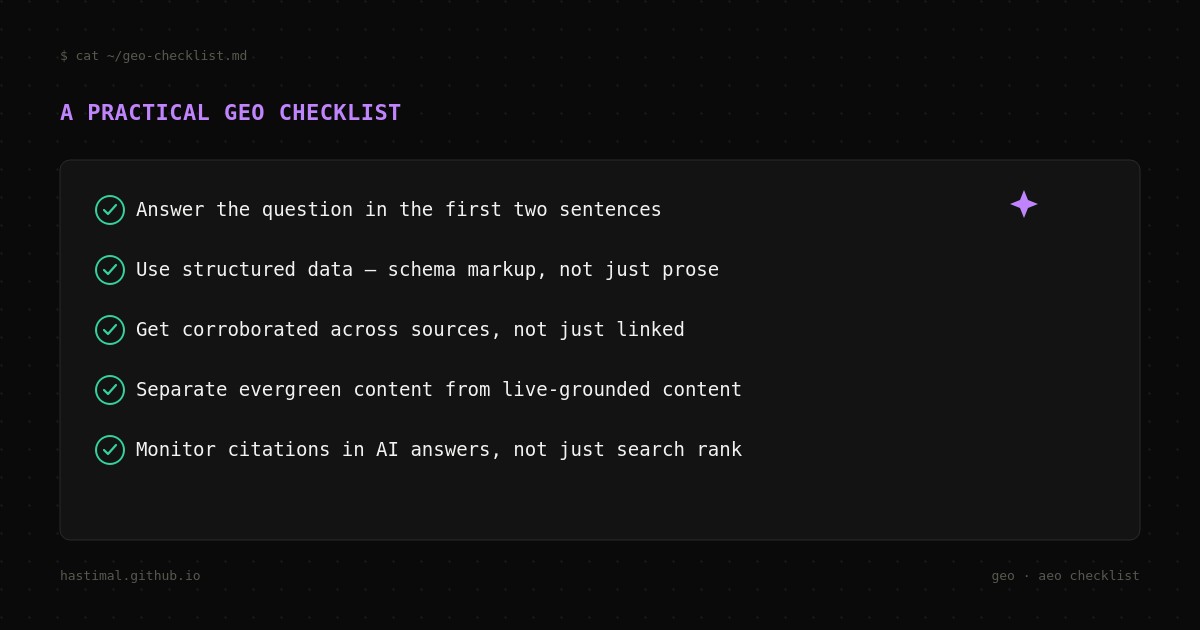
- Answer the question in the first two sentences. Both crawlers and language models weight the opening of a section heavily.
- Use structured data — schema markup isn't just an SEO relic, it's some of the cleanest signal an AI system can parse without inference.
- Get corroborated, not just linked. A fact repeated accurately across five independent sources is worth more to an answer engine than one strong backlink.
- Separate your "training data" content from your "live grounding" content. Evergreen explainer content earns its way into model training over time; time-sensitive content needs to be structured for real-time retrieval instead.
- Monitor citations, not just rankings. Track when and how often your brand shows up inside AI-generated answers, not just where your URL sits in a results page.
Where this is headed
The brands treating GEO as a checkbox added to their existing SEO process are going to be consistently behind the ones treating it as its own discipline with its own success metric. The overlap with SEO is real and worth using — but the overlap is also exactly why it's easy to underinvest in the parts that don't overlap at all.